You get the call. A programme is in trouble...
Someone senior gives you the brief. It's usually focused and specific: a supplier relationship that's broken down, a migration that's stalled, a programme that needs a final push. They've thought about it. They know what they need.
And they're not wrong. But in thirty years of walking into troubled programmes, I've found there's almost always more to it than the brief suggests. Not because anyone is hiding anything, but because these situations are inherently layered, and when you're inside them, it's difficult to see the full picture.
That's where the value of an independent assessment comes in. Not to prove anyone wrong, but to peel back the layers and understand what's really driving the problem before committing to a course of action.
Four Programmes. Four Realities.
I want to tell you about four programmes I've been brought into. Different industries, different scales, different decades. What they had in common was this: the initial brief captured part of the picture, but the full reality turned out to be considerably more complex.
The Financial Services Programme
A €29 million international infrastructure programme. The brief centred on a breakdown in the relationship with the outsource supplier. My mandate was to assess whether it could be salvaged, explore alternatives, or recommend closure.
The supplier relationship was genuinely strained, that much was accurate. But it was one of five compounding problems.
The contract was vague and open to misinterpretation, with no dispute resolution mechanism. Internal teams were disengaged, driven by concerns, never formally acknowledged, about what the programme meant for their roles. Of the thirty-odd business units that were supposed to migrate into the new shared service, only two showed genuine appetite for it. A second consultancy was operating alongside the incumbent supplier, adding complexity. And the business case, produced by a respected analyst firm, was built on assumptions that didn't hold up under scrutiny.
The supplier relationship was real. But it was a symptom of something deeper: a programme that lacked the foundations to succeed.
Working through scenarios with the programme finance controller, varying which business units would migrate, in what combinations, at what scale, none of them produced a compelling return. The answer was consistently either marginal benefit or unacceptable risk.
The right recommendation was to close it down. Not because the people involved had failed, but because the programme itself was never going to deliver what the business case promised. Presenting that conclusion clearly, with evidence, was the most useful thing I could do.
The Utilities Migration
A major data centre migration for a utilities business. The incumbent network provider had expanded their footprint through a bundled deal, WAN upgrade, hosted telephony, and managed co-location. The programme had stalled. I was brought in as Head of Infrastructure to get it moving.
What emerged was that the supplier's core strength was WAN networking, it was their bread and butter. But the managed data centre service was a different proposition entirely. The operational readiness simply wasn't there: no defined processes, no service catalogue, no operational playbook. The offshore team managing the co-location lacked visibility of what they had, how it was configured, and who was responsible for what.
The boundaries of who was responsible for what, and to what standard, were poorly defined. And the supplier was going through an acquisition during this period, which created distraction at exactly the wrong time.
At one critical point during the migration, a failure on the supplier's equipment caused a significant outage. Their proposed resolution would have resulted in permanent corruption of critical business data. I refused it. The data was saved.
This one didn't end in closure. We got through it. The workloads migrated, the old data centre was decommissioned. But a significant part of the job was building the operational processes and clarifying the contractual boundaries that should have existed from day one.
The Logistics Infrastructure Programme
A £12 million infrastructure programme at a logistics business, triggered by a major incident at the primary data centre. The plan was to close two facilities and migrate everything into a new managed service. By the time I arrived, the programme was roughly 80% complete. I was there to provide the final push.
The challenge was that the managed service provider's facility didn't have sufficient capacity to absorb the full workload. The core objective, closing the primary data centre, wasn't achievable within the programme's parameters. The business case hadn't been fully validated against what was actually deliverable.
I got the secondary facility decommissioned, that was a tangible outcome. But the primary data centre couldn't close. Servers were repurposed to keep remaining workloads running on-premise. The internal team were capable but chronically under-resourced, having been consistently denied the investment needed to keep systems properly maintained.
That vulnerability was exposed when WannaCry hit. The business was affected. We got through it, but it was a punishing experience, and one that was avoidable had the environment been properly maintained.
By any honest measure, this programme didn't fully achieve what it set out to do. The lesson I take from it is straightforward: you have to understand your workloads before you commit to a migration strategy, and you have to keep sight of whether the intended outcome is actually achievable.
The Retail Estate
A 150-store retail chain, built through acquisition with very little done to standardise the infrastructure. I came in to backfill the Head of IT role. The brief focused on broken supplier relationships.
The supplier issues were real, almost every key relationship had deteriorated. The incumbent data centre provider, the network provider, the telephony provider, the support contract provider. Multiple suppliers doing overlapping things with no structure or governance around any of it. The network across 150 sites was poor, with upgrade equipment that had been purchased and was sitting unused.
Part of the challenge was internal: the pace of change in strategic direction made it difficult for suppliers, and the internal team, to maintain consistent delivery. It's a dynamic I've seen in other organisations, and it's rarely anyone's fault in isolation. It's usually a combination of circumstances that erodes relationships over time.
We rebuilt every broken supplier relationship. Got all key suppliers physically in the room, established regular service review cadences, and shifted the dynamic from adversarial to something closer to genuine partnership. Completed a data centre migration, outsourced the service desk, rolled out a new network across the sites, introduced change control discipline, and refreshed the end user estate. When the point-of-sale replacement programme hit problems because the vendor's design hadn't accounted for some operational realities on the ground, we used the improved relationships to resolve it quietly.
This wasn't one big recovery. It was fixing the basics across the board, systematically, methodically, relationship by relationship.
The Pattern
Four programmes. Four industries. Four different scales. And four different outcomes: controlled closure, recovery through persistence, partial delivery, and ground-up rebuilding.
But the approach was the same every time. It maps to three phases that I've come to rely on in every engagement.
Discovery
Start with the brief, but don't stop there. The brief is valuable, it tells you where the pain is being felt and what matters most to the people commissioning the work. But it's a starting point, not a diagnosis.
Do your own assessment. Talk to the people doing the work as well as the people commissioning it. Read the contracts, properly, not just the executive summary. Look at the supplier relationships, the internal dynamics, the business case assumptions. Understand what's driving the situation, not just what's visible on the surface.
In every one of these four engagements, the assessment revealed dimensions that weren't in the original brief. Not because anyone was withholding information, but because complex programmes generate their own blind spots. An independent pair of eyes sees different things, and that difference in perspective is often where the real value begins.
Design
Once you understand the full picture, you can design the right response. But the critical discipline here is honesty about which outcome you're designing for.
Not every programme should be recovered in its original form. The financial services programme was never going to deliver what the business case promised, no combination of scenarios made it work. Recommending closure wasn't a failure of recovery. It was the most valuable outcome: an evidence-based conclusion that saved the organisation from spending further time and money arriving at the same answer.
Some programmes need you to hold the line. The utilities migration needed someone who would build the missing processes, clarify the contractual boundaries, and make the right call when things got critical.
Some programmes need you to recognise what's achievable and deliver that honestly. The logistics programme was never going to close both data centres. Delivering what could be delivered, rather than pretending the original vision was still viable, was the more honest path.
And some situations need you to step back from the individual programme and fix the underlying environment. The retail estate didn't need a single programme recovered, it needed someone to rebuild relationships, introduce basic governance, and create the foundation that everything else could sit on.
Delivery
Delivery in a recovery context is different from normal delivery. The political dimension is heightened. Contracts may be contested. Suppliers can be defensive. Internal teams may be fatigued. Trust is often low.
The practical work varies, contract clarification, process creation, supplier engagement, workload migration, scope management. But what ties it together is a commitment to honest communication. Telling stakeholders what's actually happening, even when the picture is uncomfortable. Presenting options clearly, with evidence, so that informed decisions can be made.
That's not always easy. But in my experience, organisations appreciate candour. They'd rather hear an honest assessment early than discover the truth late.
What Recovery Actually Means
There's an assumption that programme recovery means getting a troubled initiative back on track, that the end state is the original vision, delivered late but delivered. In my experience, that's rarely the whole story.
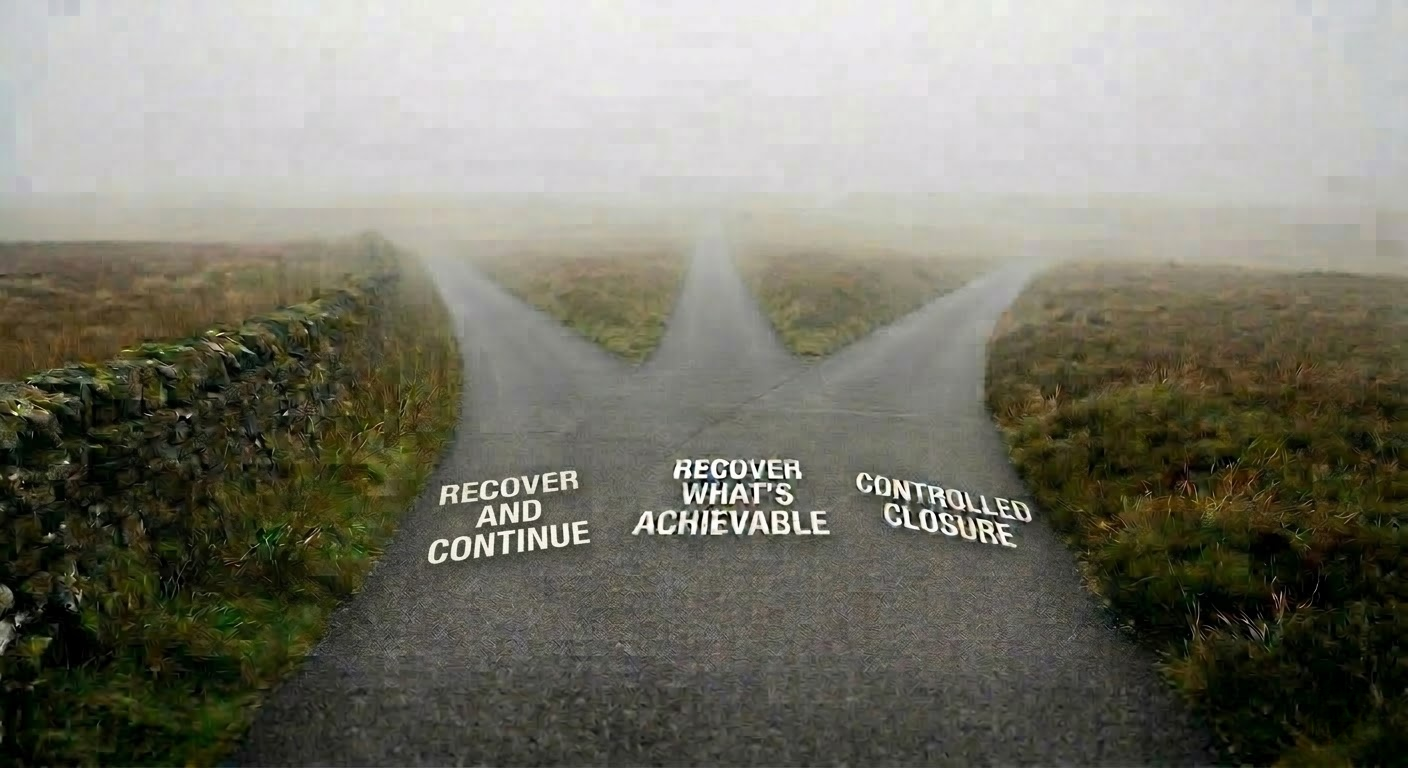
Recovery has three possible outcomes:
Recover and continue. The programme is fundamentally sound but execution has gone wrong. Fix the execution, rebuild the relationships, hold the line. The utilities migration was this.
Recover what's achievable. The programme was overambitious or underfunded from the start. Deliver what can be delivered, be honest about what can't, and help the organisation adjust. The logistics programme was this.
Controlled closure. The programme cannot deliver a viable return under any realistic scenario. Present that conclusion clearly, with evidence, and help the organisation make an informed decision. The financial services programme was this.
The retail estate sits in a different category, it wasn't one programme to recover, it was a whole environment to stabilise. But the principle is the same: assess honestly, design the right response, and deliver with transparency.
Dealing with a transformation that's gone sideways? I work with organisations as an interim leader to get programmes back on track. Let's have an honest conversation about where you are.
Start a Conversation →
 About Paradigm-ICT
Paradigm-ICT is an interim IT transformation consultancy specialising in programme recovery, complex transition delivery, and pragmatic technology enablement across manufacturing, utilities, retail, and financial services.
Founded on 30 years of hands-on operational experience — starting in business operations, not IT — we bring a business-first perspective to technology leadership that most consultancies can’t.
Learn more →“I need something that actually works the way I work.”
“The CRMs that fail are the ones built for reporting, not for doing.”
“If the people doing the work won’t use it on a bad day, it’s not a tool — it’s a chore.”